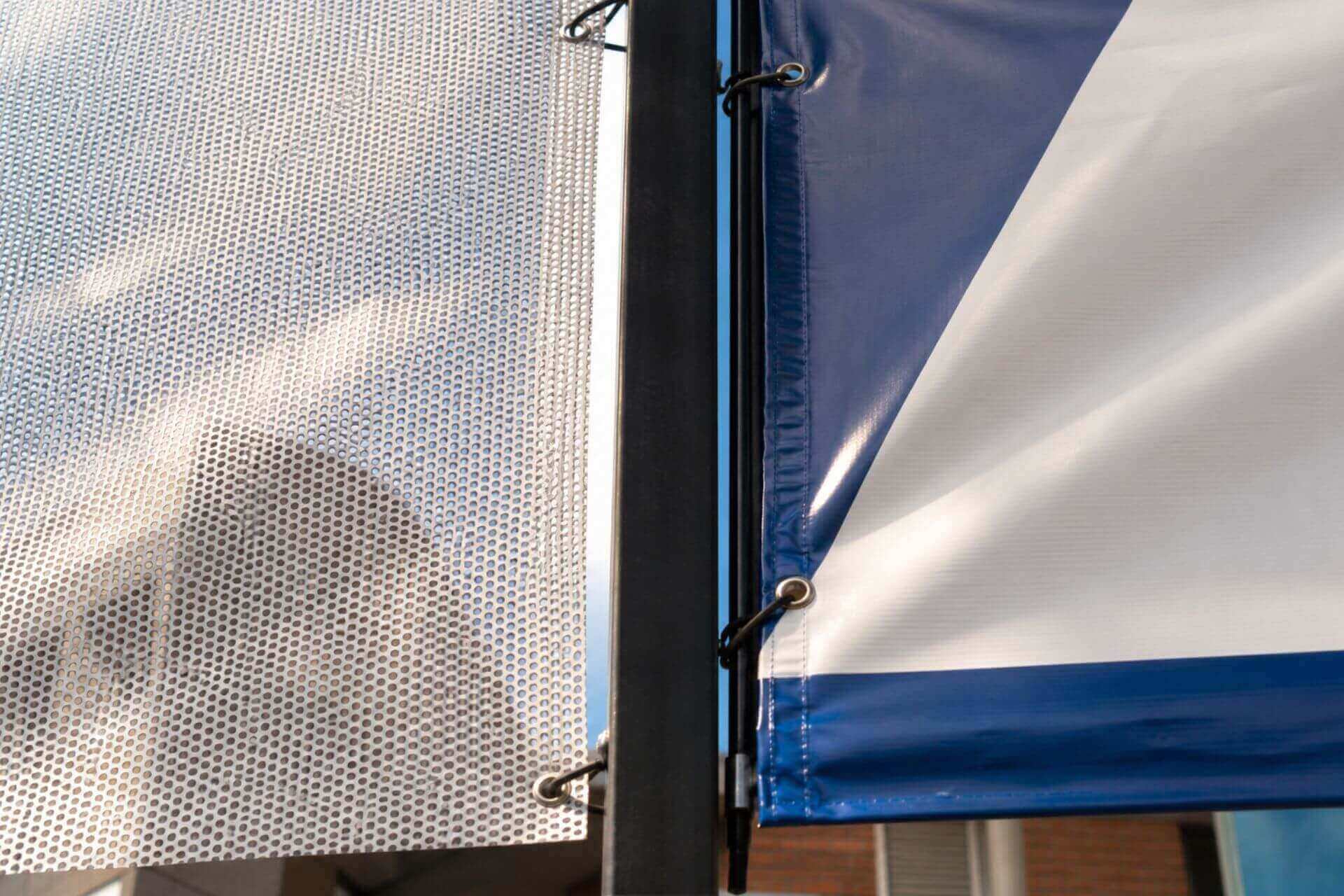
What Are The Differences Beween Mesh Vs Vinyl Banners?
Picture this: You’ve invested in a beautiful banner for your business. It looks amazing. Then a strong wind hits, and suddenly it starts flapping, or worse, tears. Your professional storefront now looks like it lost a battle with nature.
You can often avoid this by choosing a banner material suited to the location.
You’ve probably heard mesh and vinyl banners mentioned before, and you might be wondering, “Aren’t they the same thing?” They are both commonly used for banners, but their construction makes them suitable for different applications.
By the end of this guide, you’ll understand the key differences between mesh and solid vinyl banners and what to consider before choosing one for your business.
What Is a Vinyl Banner?
Before we compare the two, let’s understand what we are working with.
A vinyl banner is a printed graphic made from a flexible PVC-based material. Unlike mesh, it has a solid surface without perforations. This creates an opaque background that can provide strong colour reproduction and clear graphics.
Here’s what makes solid vinyl useful:
- Solid, non-breathable construction
- Available in different finishes, including matte and gloss
- Provides a consistent surface for printed graphics
- Suitable for many indoor and outdoor applications
- Available with different weights and finishing options
You’ll see solid vinyl banners used for retail promotions, trade shows, construction signage, events, storefronts, and other business applications.
What Is a Mesh Banner?
A mesh banner is made from a perforated material with numerous small openings across its surface. These openings let air pass through the graphic, reducing the solid surface exposed to wind.
Here’s what makes mesh signage different:
- Breathable construction: Air can pass through the openings.
- Partial visibility: Depending on the mesh construction and viewing conditions, some visibility may remain through the banner.
- Reduced wind load: The open structure can make it more suitable for exposed locations.
- Outdoor applications: It can be useful where wind is an important consideration.
Mesh banners are commonly used for construction fencing, building exteriors, outdoor events, parking areas, and other locations where airflow matters.
Is Mesh the Same as Vinyl?
No, although the two materials are related.
A standard vinyl banner has a solid surface, while mesh is a perforated banner material. Both can be PVC-based, but the presence of openings changes how each one performs.
Think of it this way:
- Solid vinyl: Blocks wind and provides an opaque printed surface.
- Mesh: Allows air to pass through and provides some visibility through the material.
The right choice depends largely on where the banner will be installed and what you need it to accomplish.
Mesh vs Vinyl Banner: Which Is Better?
There is no single material that works best for every banner. Each option has advantages depending on the application.
Where Solid Vinyl Excels
- Strong visual impact: The solid surface provides a consistent background for text, logos, photographs, and graphics.
- Opacity: It is suitable when you want the banner to provide full visual coverage.
- Versatility: Solid vinyl works for many indoor and outdoor applications.
- Print appearance: The uninterrupted surface can provide clear, detailed graphics.
- Indoor applications: It can work well for trade shows, offices, retail displays, events, and other protected environments.
Where Mesh Shines
- Wind management: The perforated construction allows air to pass through instead of hitting one continuous surface.
- Outdoor exposure: It can be useful in locations where wind is a major consideration.
- Partial visibility: Certain mesh products allow people to see through the material to some extent.
- Reduced water retention: Openings allow water and air to move through the material.
- Large outdoor installations: Mesh can be considered for construction fencing, building exteriors, parking areas, and other exposed locations.
The exact performance of either material depends on its construction, installation method, exposure, and the specific product selected.
So, What Is the Best Material for a Banner?
Ask yourself these questions before choosing.
Will the Banner Be Used Indoors or Outdoors?
For indoor applications, solid vinyl can provide a clean, opaque surface with strong graphic reproduction.
For outdoor installations, consider the environment first, particularly if the banner will be exposed to significant wind.
Is the Location Calm, Breezy, or Windy?
A protected location may suit solid vinyl.
If the banner will be installed in an exposed area, mesh may be worth considering because its perforations allow air to pass through.
However, material alone doesn’t determine whether an outdoor banner will stay secure. Proper mounting and installation matter just as much.
Do You Need Complete Opacity?
If you need a solid background that completely covers what is behind the banner, solid vinyl is generally the more appropriate option.
If you need some visibility through the material, a suitable mesh product may be a better fit.
What Is Your Budget?
Both options are available at different price points. The final cost depends on factors such as size, material specification, quantity, finishing, artwork, and installation.
Instead of comparing material prices alone, consider the location’s requirements and how the banner will be used.
How Long Do Mesh Banners Last?
There is no universal lifespan for an outdoor mesh banner. Its durability depends on the material specification, printing method, installation, sunlight, wind exposure, cleaning, and general handling.
Some factors that can affect its service life include:
- Wind exposure: Mesh can reduce wind load, but repeated exposure can still put stress on the material and attachment points.
- Sunlight: Prolonged UV exposure can gradually affect printed colours and materials.
- Installation: Secure attachment and appropriate finishing can help reduce unnecessary stress.
- Maintenance: Regular cleaning and inspection can help identify damage before it becomes a larger problem.
Always check the manufacturer’s specifications for the material when lifespan is a key consideration.
Why Businesses Choose Mesh Banners Outdoors
Mesh can be useful for a variety of outdoor applications where wind and visibility matter.
Retail Storefronts
A mesh graphic can provide branding while allowing some visibility through the material, depending on the product and installation.
Parking Lots and Dealerships
Open outdoor areas can experience significant wind. A breathable banner may be worth considering for these environments.
Construction Sites
Mesh banners can be installed on suitable fencing or structures to display project information, branding, or other graphics while allowing airflow.
Rooftop and Building Installations
Highly exposed locations require careful consideration of both the banner material and installation system. Mesh can reduce wind load compared with a solid sheet, but the full installation still needs to suit the site.
Outdoor Events
For temporary outdoor displays, mesh may be useful when wind is a concern. Event organisers should still consider venue requirements and installation conditions.
Why Businesses Prefer Mesh Outdoors
The main practical advantage of mesh is its ability to allow airflow through the material. This can reduce the wind load compared with a solid banner, making it a useful option for certain exposed installations.
It can also provide partial visibility where completely blocking a fence, window, or other surface is not desirable.
However, mesh is not automatically the right choice for every outdoor application. Consider the graphic size, mounting surface, wind conditions, exposure, and installation method.
Custom Vinyl Banner Solutions
Solid vinyl can work particularly well for:
- Event Backdrops: Trade shows, conferences, and corporate events can use solid graphics for branded backgrounds.
- Indoor Signage: Offices, retail interiors, and event spaces can benefit from an opaque printed surface.
- Temporary Promotions: Sales, launches, and other campaigns can use custom banners with clear promotional messaging.
- Brand Consistency: Solid banners provide a consistent surface for logos, colours, photographs, and other brand elements.
- Detailed Graphics: The uninterrupted surface can help when your design includes small text or detailed imagery.
For unusually shaped graphics, discuss the available material and finishing options with your printer rather than assuming either material can be cut into any shape.
How Do You Choose Between Mesh and Vinyl?
| Factor | Solid Vinyl | Mesh |
|---|---|---|
| Construction | Solid surface | Perforated surface |
| Wind exposure | Better for protected locations | Useful where airflow is important |
| Opacity | High | Partial visibility may be possible |
| Graphic surface | Consistent, uninterrupted | Perforated |
| Indoor use | Well suited | Usually less necessary |
| Outdoor use | Suitable depending on conditions | Often useful in exposed locations |
| Visibility through material | No | Possible, depending on mesh |
| Best starting point | Events, promotions, indoor displays, protected outdoor areas | Construction fencing, exposed outdoor areas, locations where wind matters |
Making Your Decision
Choosing between mesh and solid vinyl comes down to how and where you’ll use your banner.
If you need an opaque surface with strong graphic reproduction for an indoor display or a protected location, solid vinyl may be a good fit. If the banner will be exposed to significant wind or you need some visibility through the material, mesh may be worth considering.
Triboro Printing can help you determine the appropriate banner material, size, and finishing options based on your project requirements. Whether you need a custom vinyl banner or a mesh graphic for an outdoor application, choosing the right material from the start can help you get better performance from your finished display.