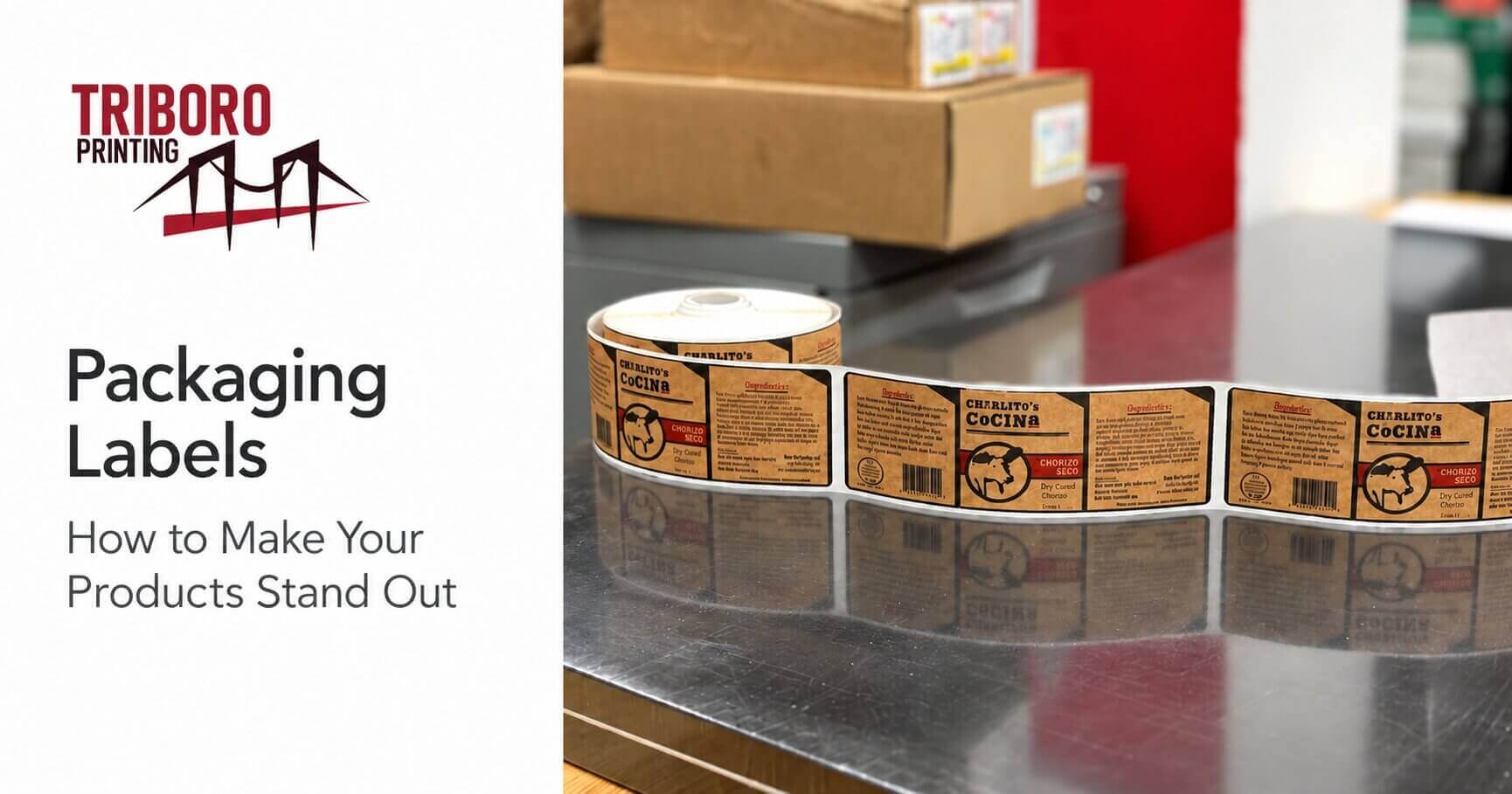
Packaging Labels: How to Make Your Products Stand Out
A customer picks up your product but cannot tell what makes it different from the one beside it. Your packaging may look attractive, yet if the product name, brand, or key details are hard to find, you could lose their attention.
That is where packaging labels can help. The right label makes your product easier to recognize, communicates essential information, and gives your packaging a consistent look. However, choosing one involves more than designing a logo. You also need to consider the packaging surface, material, label format, and printing requirements.
Here is how to choose labels that suit your products, budget, and customers.
Why Do Packaging Labels Matter?
A label does more than display your brand name. It helps customers understand what they are buying and makes your products easier to identify.
Well-designed labels can help you:
- Build brand recognition: Consistent logos, colors, and typography make your products easier to recognize.
- Share essential information: Display product names, ingredients, instructions, and other relevant details.
- Create a professional appearance: A well-sized label with readable text helps your packaging look organized.
- Differentiate your products: Use a clear design to distinguish product varieties, sizes, or flavors.
- Support customer decisions: Accurate information helps shoppers understand the product before purchasing it.
For small businesses, labels also offer a practical way to brand bottles, jars, boxes, bags, and other packaging without redesigning the entire container.
Types of Packaging Labels: Which Format Should You Choose?
The best format depends on how many labels you need and how you plan to apply them.
| Label format | How it works | Best suited for |
|---|---|---|
| Roll labels | Labels supplied on a continuous roll for peeling and application. | Higher-volume labeling and use with compatible dispensers. |
| Sheet labels | Multiple labels arranged on a flat sheet. | Manual application and projects that need individually accessible labels. |
| Individual labels | Separate labels prepared for application to packaging. | Product branding on bottles, jars, boxes, and other containers. |
If you label products in large quantities, roll labels can make the process more organized. However, sheets or individual labels may be more convenient for smaller manual jobs. Before ordering personalized labels, discuss your production volume and application method with your printer.
How to Choose the Right Label Material
A label that works on a cardboard box may not perform well on a refrigerator-stored bottle. Therefore, consider the packaging surface and the conditions the label will face.
- Paper labels: Consider these for dry packaging and products that don’t need significant moisture resistance.
- Waterproof labels: Use these for products exposed to moisture, refrigeration, handling, or outdoor conditions. Confirm the material’s suitability for your specific application.
- Clear labels: These let the packaging show through, making them a good choice for transparent bottles and jars.
- Vinyl labels: Consider vinyl when selecting a label for specific packaging or handling requirements. Confirm the suitable material and adhesive with your printer.
- Gloss and matte finishes: Gloss can create a shiny appearance, while matte offers a less reflective look. Choose based on your design and readability needs.
Before approving an order, check that the label adheres properly to your actual packaging. Curved surfaces, moisture, temperature, and frequent handling can affect label performance.
Essential Label Information: What Should You Include?
An attractive design cannot replace clear product information. Before sending your artwork for printing, make sure the label includes the details your customers need.
Depending on your product and the applicable regulations, these may include:
- Product name: Identify the product clearly.
- Brand name and logo: Make your business recognizable.
- Net quantity: Show the required weight, volume, or count.
- Ingredients and allergens: Include the applicable information for food products.
- Directions and warnings: Add relevant instructions or safety information.
- Business details: Include the manufacturer, packer, or distributor information required for your product.
- Barcode or QR code: Add these when needed for retail scanning or access to additional product information.
Requirements vary by product category and market. For food products sold in the United States, consult the FDA’s food labeling guidance and check the current requirements that apply to your product.
How to Make Your Labels Stand Out
Once you have covered the essential details, focus on making the design easy to notice and read.
- Create a clear visual hierarchy. Make the product name and brand easy to find. Keep supporting information readable without letting it overwhelm the main message.
- Choose colors carefully. Strong contrast helps customers read the text. Also, use consistent brand colors across your product range to make different items feel connected.
- Match the label to the packaging. Measure the available area before finalizing the design. Leave enough space around the edges and avoid placing important information over curves or seams.
- Keep the layout simple. Too many fonts, images, and promotional claims can make the label difficult to understand. Focus on the information that matters most to your customers.
- Check the proof before printing. Review spelling, dimensions, colors, alignment, and small text. A careful review can help you catch mistakes before the full order goes into production.
Options and Pricing: What Affects Label Costs?
There is no single price for every product label order. The final quote depends on the specifications and production requirements.
| Pricing factor | What to consider |
|---|---|
| Quantity | The number of labels you need and how we’ll produce the order. |
| Size and shape | The dimensions and cutting requirements of your design. |
| Material | Whether paper, clear, vinyl, or another suitable option meets your needs. |
| Finish | Whether you prefer gloss, matte, or another available finish. |
| Format | Whether sheets, individual labels, or rolls suit your application process. |
| Artwork preparation | Whether you supply print-ready artwork or need design assistance. |
To request an accurate quote, provide your label dimensions, quantity, packaging type, preferred material, finish, and application method. If you use a labeling machine, share its specifications so the printer can assess the requirements.
Where Can You Get Custom Packaging Labels Printed in NYC?
Triboro Printing offers custom label and printing in NYC for bottles, jars, boxes, bags, candles, cosmetics, food packaging, shipping, and retail products. Its services include waterproof labels, roll labels, and label preparation as sheets, individual pieces, or rolls, depending on your needs.
You can submit your own artwork or ask our design team for assistance. We accept AI, PDF, EPS, JPG, and PNG files. Before production, the team provides a digital proof for you to review the size, shape, colors, layout, material, finish, and placement. It also checks artwork details such as bleed and readability.
To discuss your requirements, visit us and request a quote. Share your product details and preferred specifications so the team can help you explore suitable options.
FAQs
A: Product labels identify an item and provide details such as its name, ingredients, or instructions. Packaging labels are applied to containers or outer packaging and can also support branding, shipping, and product identification.
A: The food label must have the product name, net quantity, ingredients, allergen details, nutrition information, storage instructions, durability dates and business details. Check the applicable regulations before printing.
Post a Comment