
Flyers vs. Brochures: Understanding the Key Differences
Flyers and brochures are both common marketing materials, but they work differently. A flyer is usually designed to communicate one message quickly, while a brochure gives you more room to explain a product, service, event, or organisation.
The right choice depends on how much information you need to share, where the material will be distributed, and how long you expect people to keep it.
What Is the Difference Between a Flyer and a Brochure?
The main difference comes down to format, amount of information, and intended use.
A flyer is generally a single sheet with a focused message. It may promote an event, special offer, new opening, announcement, or service. Because readers can understand the main point at a glance, flyers work well for broad distribution.
A brochure usually has multiple panels or pages created through folding or binding. This gives you more space to explain different aspects of a business, product, or service in a structured way.
Neither format is limited to one specific purpose. A business could use a flyer for a promotional campaign and a brochure to provide more detailed information to interested customers.
Flyers vs. Brochures at a Glance

| Flyers | Brochures |
|---|---|
| Usually a single sheet | Often folded or made up of multiple pages |
| Focus on one main message | Can cover several related topics |
| Quick to read | Designed for more detailed reading |
| Easy to distribute in large quantities | Often handed to people who want more information |
| Suitable for short-term promotions | Useful as an ongoing information resource |
| Usually simpler to produce | May involve additional folds, finishing, or binding |

Cost and Production Differences
A flyer is often more economical when you need a large quantity of simple promotional material. Its straightforward format can also make production and distribution easier.
Brochures may cost more because they can involve additional panels, heavier paper, special finishes, or binding. However, the final price depends on factors such as size, quantity, stock, colour, folding, and finishing.
For example, a basic flyer printed in bulk may cost less per piece than a folded brochure with premium stock and finish. Comparing quotes with the same specifications gives you a more useful idea of the real difference.
Size and Format Options
Flyers come in a range of sizes. Letter-size sheets are common, but smaller formats can also work for handouts, inserts, or direct distribution.
Brochures offer more structural options. Common formats include:
- Bi-fold: A sheet folded once to create four panels.
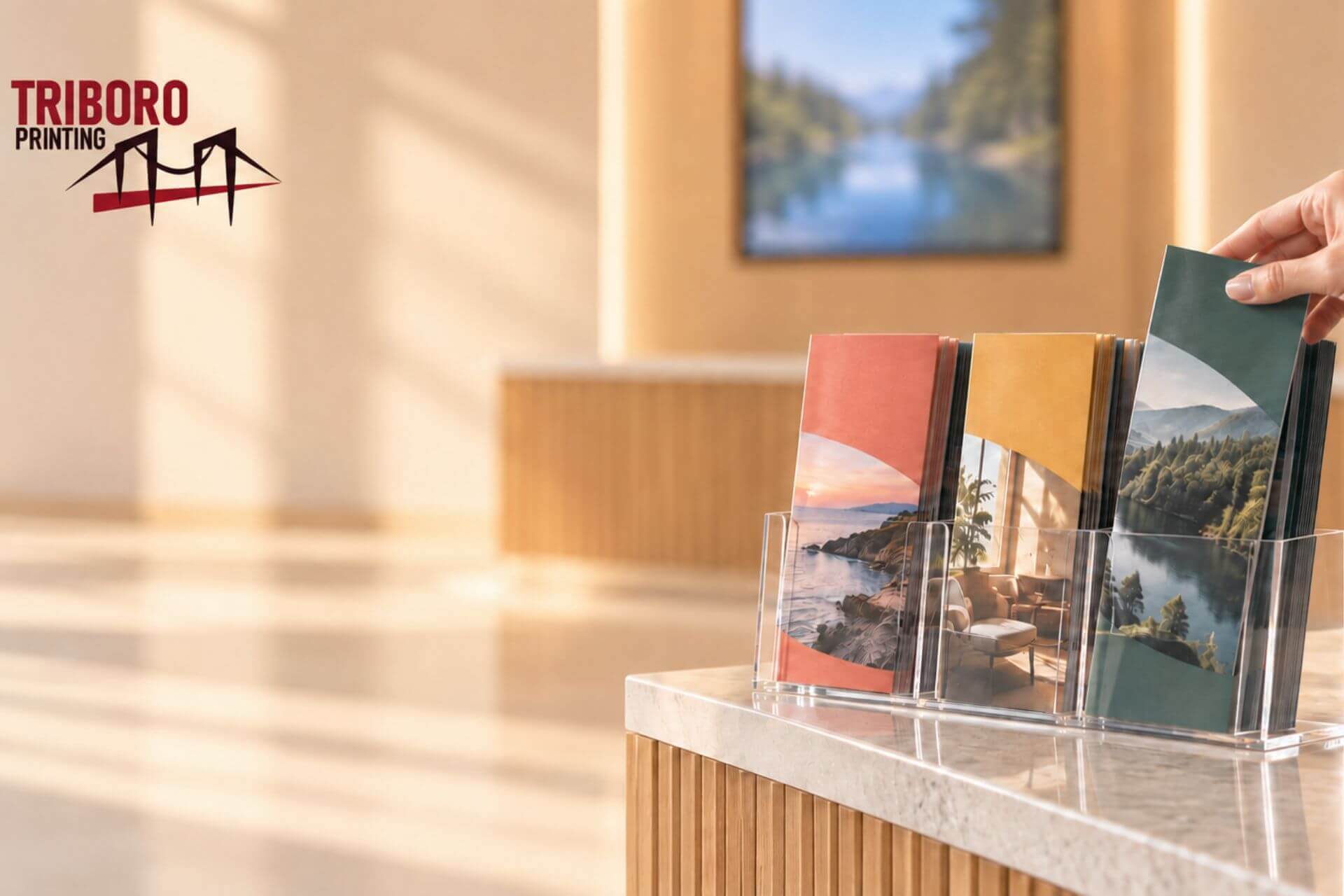
- Tri-fold: A sheet folded into three sections, creating six panels across both sides.
- Z-fold: Panels fold in alternating directions for a more segmented layout.
- Gate fold: Outer panels fold inward toward the centre.
- Accordion fold: Multiple panels fold back and forth in a continuous sequence.
Choose a format that supports how the information is organised, rather than simply adding more sections.
When Should You Use a Flyer?
Flyers are useful when the audience needs to understand the message quickly.
Common applications include:
- Event announcements
- Restaurant promotions
- Sales and limited-time offers
- Grand openings
- Community notices
- Service promotions
- Product launches
- Local campaigns
You can distribute them in stores, hand them out at events, include them with orders, post them on community boards, or use them as part of a direct-mail campaign.
If you can communicate the message clearly with a headline, a few supporting details, an image, and a call to action, a flyer may be enough.
When Is a Brochure More Suitable?
A brochure becomes useful when people need more information before taking action.
For example, a company might use one to explain its services, present product options, introduce a range of solutions, or provide information about an organisation.
They are commonly used at:
- Trade shows
- Business meetings
- Reception areas
- Sales appointments
- Tourism locations
- Retail environments
- Client presentations
Because they offer more room to organise information, brochures can guide readers from an introduction to specific details and finally to a next step.
Design and Content Differences
A flyer usually needs a strong visual hierarchy because the reader may spend only a few seconds looking at it. The headline, main image, offer, and call to action should be easy to identify.
A brochure can use a more structured layout. Different panels or sections can each serve a purpose, such as introducing the business, explaining services, presenting features, answering common questions, and providing contact details.
That extra space does not mean every panel should be filled with text. Good organisation and enough white space still matter.
Which One Should You Choose?
Start with the message, not the format.
Choose a flyer when:
- You have one focused message.
- You need to distribute the material widely.
- Readers should understand the offer quickly.
- The campaign has a short-term or event-based purpose.
Consider a brochure when:
- You need to explain several aspects of a product or service.
- Customers may need more information before contacting you.
- The material will be used during sales conversations or meetings.
- You want a resource that people can keep for later reference.
You can also use both. For example, a business could use flyers to attract attention to a campaign and brochures to provide additional information to people who want to learn more.
Choosing Paper and Finishing
Your choice of stock can affect how the finished material feels and performs.
A lightweight stock may be practical for large-volume distribution, while a heavier option can provide more structure and a more substantial feel. Coated and uncoated stocks can also produce different visual results.
For brochures, folding needs additional consideration. The stock should be suitable for the chosen fold, particularly when using heavier material. Scoring may be helpful for some projects to achieve cleaner folds.
Discuss the intended use, quantity, size, and finishing requirements with your printer before selecting the final specifications.
Conclusion
Flyers and brochures can both support a marketing campaign, but they serve different communication needs. Flyers work well for focused messages and broad distribution, while brochures provide more space for organised, detailed information.
The best format depends on what you need the audience to understand and how you plan to distribute the material. If you need help choosing the right format, paper, or finishing options, Triboro Printing provides professional flyer and brochure printing services in NYC.
FAQs
A: Yes. A brochure can be produced from a single sheet that is folded into multiple panels. The term does not necessarily mean a bound multi-page document.